The Solitary (Intrapersonal) Learning Style
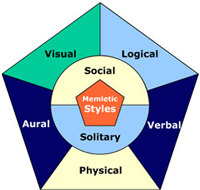
If you have a solitary style, you are more private, introspective and independent. You can concentrate well, focusing your thoughts and feelings on your current topic. You are aware of your own thinking, and you may analyze the different ways you think and feel.
You spend time on self-analysis, and often reflect on past events and the way you approached them. You take time to ponder and assess your own accomplishments or challenges. You may keep a journal, diary or personal log to record your personal thoughts and events.
You like to spend time alone. You may have a personal hobby. You prefer traveling or holidaying in remote or places, away from crowds.
You feel that you know yourself. You think independently, and you know your mind. You may have attended self-development workshops, read self-help books or used other methods to develop a deeper understanding of yourself.
You prefer to work on problems by retreating to somewhere quiet and working through possible solutions. You may sometimes spend too much time trying to solve a problem that you could more easily solve by talking to someone.
You like to make plans and set goals. You know your direction in life and work. You prefer to work for yourself, or have thought a lot about it. If you don't know your current direction in life, you feel a deep sense of dissatisfaction.
Common pursuits and phrases
Those that have a strong solitary style include authors, researchers, park rangers and security guards. Peak performers in any field often have a good solitary style behind other more dominant styles.
You are more likely to use phrases that reflect your other dominant styles. Here are some other phrases you may also use:
- I'd like some time to think it over.
- This is what I think or feel about that.
- I'd like to get away from everyone for a while.
- I'll get back to you on that.
Learning and techniques
You prefer to learn alone using self-study. When you spend time with an instructor or a teacher, you often only clarify information you haven't be able to clarify yourself. You may dislike learning in groups.
Don't be afraid to ask questions like 'What's in this for me?' 'Why does this matter?', 'How can I use this idea?' Be aware of your inner thoughts and feeling towards various topics. This is because these inner thoughts have more of an impact on your motivation and ability to learn than they do in the other styles. Here are a few ideas to help this along:
- Spend more time on the 'Target' step of the Memletic Approach. Set your goals, objectives and plans. Define ultra-clear visualizations or scripts of what life is like once you've achieved your goals. Understand your reasons for undertaking each objective, and ensure that you are happy with your learning goals.
- Align your goals and objectives with personal beliefs and values. If there is misalignment, you may run into issues with motivation or confidence. It's not always obvious what the underlying cause is. If you suspect a misalignment, try some of the techniques like 'five whys' and 'seventy by seven' to flush these issues out. Scripting and assertions also help highlight issues. If you script your goal and you find you don't like certain parts of it, that's probably a hint that you have some misalignment.
- Create a personal interest in your topics. An example for
pilots might be to learn more about other aviators, both current and past.
Why do others find aviation interesting? What is in it for them? What
keeps them motivated? Why do they work in the field?
You may also want to look at the people behind your books or material. What was their motivation to create it? Why do you think they organized the material in the way they did? Can you ask them? - Keep a log or journal. You may want to keep one separate from your normal journal or training log. Include extra information about your thoughts and feelings. Outline your challenges, ideas on how to overcome them, and what worked. Write down what works well and doesn't work well for you. While you are studying, be aware of thoughts or concerns that arise. Write them down and come back to them. Discuss with others later if needed. Bear in mind it may be more efficient to put something that confuses you aside, and ask others later. This is often better than spending too much time trying to work it out yourself.
- When you associate and visualize, highlight what you would be thinking and feeling at the time. You may want to do most of your visualization and association in private. I suggest you also try talking to others with more experience to get some idea of what thoughts and feelings they have in various circumstances.
- Assertions are important for you. You drive yourself by the way you see yourself internally. Assertions are a good way to ensure your internal self-image matches your learning objectives. This also applies to the scripting techniques, so include your internal thinking and feelings in your scripts.
- Modeling is a powerful technique for you. Don't just model behaviors and appearance. Try to get 'inside their heads' and model the thought patterns and feelings you believe they have in various circumstances. You can gain ideas by talking to people or reading biographies. Remember you don't have to find a single perfect model. Create a model that combines several people.
- Be creative with role-playing. You don't always need other people to role-play with, because you can create plenty of people using visualization! For example, you can visualize your instructor beside you, or a colleague and you practicing a procedure or skill. Work with them and talk to them while you visualize. An advantage of this form of role-playing is that you can control their behavior!
- When changing behaviors and habits, you need to have a strong desire to make the changes you want. Explore the benefits of making a change, and visualize scenarios in which you've already made the change. If you don't believe strongly in the benefits, you may find it difficult to change the behavior.
- Your thoughts have a large influence on your performance and often safety. Your thoughts are just as much part of a system as is the physical equipment you are using, such as an aircraft, car or boat. In addition, other people are also part of those systems, so be aware that their thoughts and feelings can affect the overall system.
- Years of refinement have made physical equipment, such as aircraft and boats, safe and reliable. For example, aircraft failure causes less than ten percent of all aircraft accidents. The largest percentage is pilot error, more than seventy percent. This is likely the case in many other fields. It's just not as visible when accidents happen. It's well worthwhile spending some time refining the reliability of your own systems.